Tell us about the job
Takes about a minute. No obligation.
A heat pump running in heating mode pulls harder on its compressor and reversing valve than it does in summer cooling, because the refrigerant circuit has to wring heat out of cold outdoor air rather than dump heat into it. Homes in Saluda County, SC run heat about five months a year, from November through March. The compressor logs its heaviest starts during those months, and the reversing valve cycles every time the unit runs a defrost sequence. When a contractor opens a repair call on a system that has been through several of these winters, worn valve seats and compressor tolerances are where the diagnostic work begins, not at the thermostat.
Refrigerant lines corrode, contactors pit, and capacitors swell on a schedule tied to what the system has actually run through, and in Saluda County that schedule is a long one. Half the homes in Saluda County, South Carolina were built in 1987 or earlier (2020-2024 ACS 5-year). A heat pump sitting in a house that old has very likely been retrofitted at least once, which means what a contractor finds when the unit comes open can differ sharply from what the permit or the nameplate suggests. Parts availability is the hinge: components sized for earlier-generation equipment are harder to source, and that gap is what turns a straightforward repair into a conversation about what can still be ordered.
The Parts of a Heat Pump a Contractor Checks First
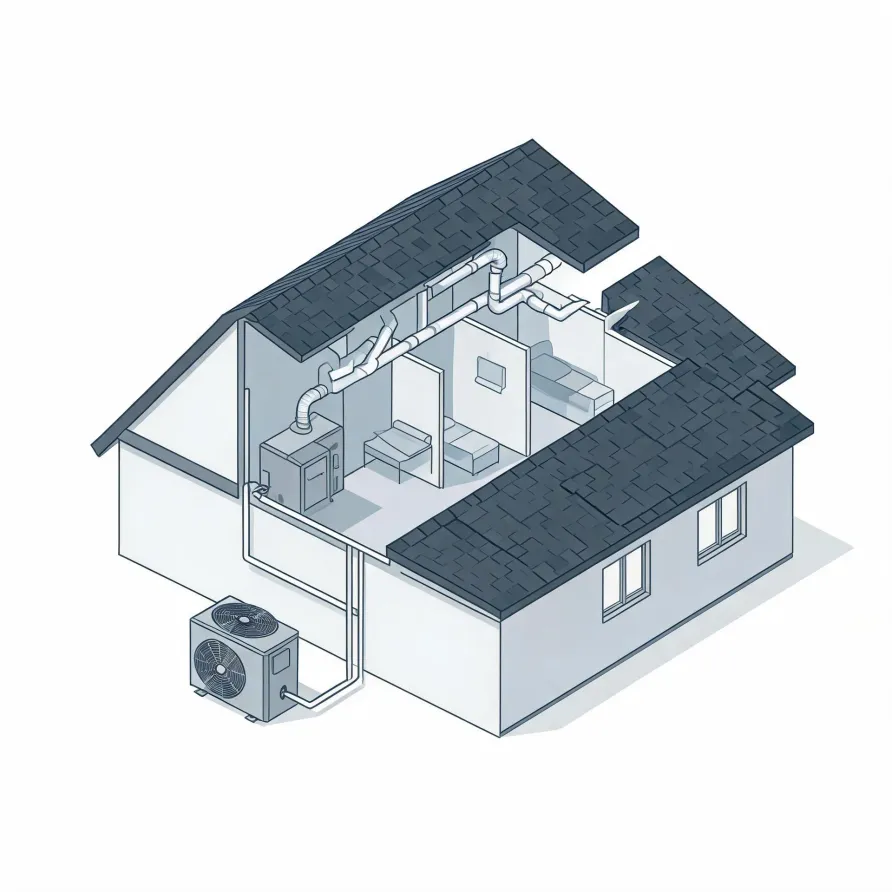
The outdoor unit is the piece most homeowners recognize: a metal cabinet set on a pad outside the house, holding a compressor and a coil. The compressor is usually where a contractor starts when a heat pump stops heating or cooling properly, since it does the hardest mechanical work. The outdoor coil sits around the compressor and is a common source of trouble when the unit runs but delivers little.
Inside the house, an air handler holds a second coil and a blower that moves conditioned air through the home. The expansion valve sits between the two coils and controls refrigerant flow. A reversing valve, also inside the refrigerant circuit, is what lets the system switch between heating and cooling, and it is one of the first things a contractor checks when the system runs in only one mode.
The drawing shows a general layout of these components, and a licensed contractor determines which parts apply to your specific house and system.
Get matched in Saluda CountySaluda County, by the numbers
103 severe weather events were recorded in Saluda County, South Carolina between 2015 and 2024.
NOAA National Centers for Environmental Information, Storm Events Database, bulk CSV export, events 2015-01-01 through 2024-12-31.Half the homes in Saluda County, South Carolina were built in 1987 or earlier (2020-2024 ACS 5-year).
U.S. Census Bureau, 2020-2024 American Community Survey 5-Year EstimatesSaluda County, South Carolina holds 9,543 housing units (2020-2024 ACS 5-year).
U.S. Census Bureau, 2020-2024 American Community Survey 5-Year EstimatesOwners occupy 78.7% of the occupied homes in Saluda County, South Carolina (2020-2024 ACS 5-year).
U.S. Census Bureau, 2020-2024 American Community Survey 5-Year EstimatesRules & Standards Behind Heat Pump Repair in Saluda County, South Carolina1 sourced rules & standards
Licensing Rules for HVAC Repair in Saluda County, South Carolina
South Carolina requires a mechanical contractor license for contracting work whose total cost of construction is greater than ten thousand dollars.
Severe Weather Events in Saluda County
Weather puts real load on heat pump systems, and the patterns a county sees over time shape how hard that equipment works and where it tends to fail. Repair needs here are tied to local conditions, which is why the record below is relevant to this service.
103 severe weather events, 2015–2024. Source: NOAA National Centers for Environmental Information, Storm Events Database.